


Yess.. Another great technology partner for EnhanceThat.
Miro and EnhanceThat are partnering up to develop fashion workflows.
And I’m so excited about this one. Great news for teams already using Miro.
But first, this confirms what we believed from the start. Fashion doesn’t need more tools. Existing tools need to be connected. That is what makes efficient workflows possible, in place of siloed tools.
And our growing group of partners helps us build such workflows. Knowing the people behind the tools, knowing the APIs, being able to work together. It just makes building something easier. And damn, it is inspiring to see what is happening in the kitchen!
Nobody forced designers and merch to use Miro
Miro holds a special place for me. In the 20 years I’ve been pushing digital ways of working in sportswear and fashion, Miro came as a relief.
It is by far the fastest and most affordable bottom-up adoption of a tool I’ve seen in fashion.
Shows up with design teams making their collection boards.
At sketch reviews
Visual line planning
Colour reviews
Store planning
Line reviews
Even at go-to-market meetings, collecting sales feedback.
And all of that without fancy integrations or fashion-specific features.
No big transformation program or army of consultants.
People just started using it. That is what I love about Miro.
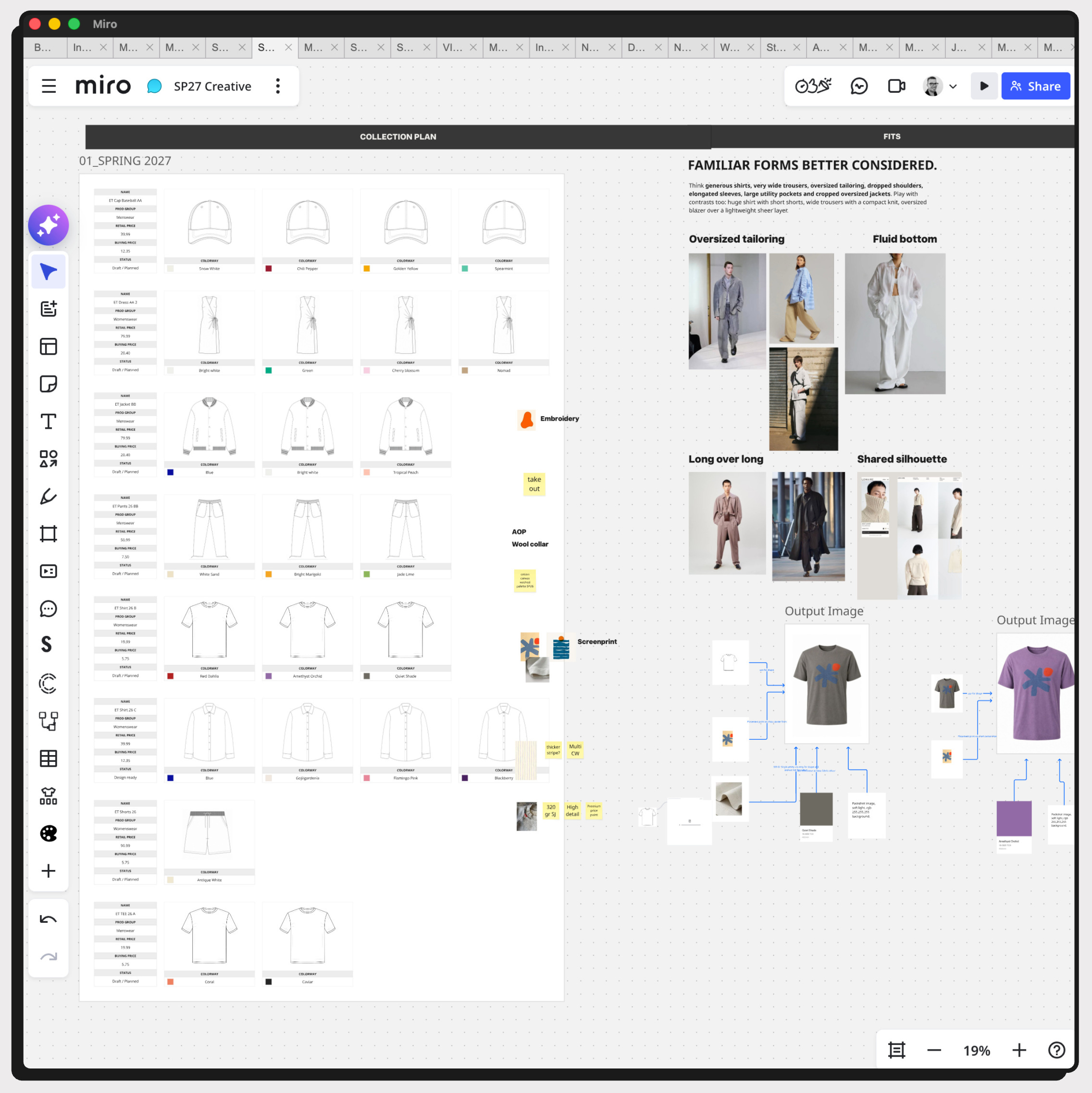
What our workflow review data is showing
In our workflow reviews, we measure manual operations and friction across fashion workflows. And we started seeing something interesting.
Making a line plan or collection board itself isn’t necessarily the problem.
Keeping it up to date is.
Teams make the most amazing line plans, style sheets, and color overviews in Miro. But they still need to look up style names and prices, pull in images from different tools and manage all the updates happening day by day.
And since so many of our clients already use Miro, we started thinking: why not bring the data to the place people love to work, instead of the other way around?
It has an immediate impact:
Less context switching. No jumping between PLM, Miro and design tools to copy-paste data and images. Stay where you are. Keep your focus.
Boards that stay up to date. Line plans, style sheets, material boards: you know you’re looking at the latest product data and images. And not everyone needs to work in PLM anymore.
People can work in the tools they actually like to use. This is an important one for anyone responsible for digital transformation. Instead of forcing everyone into PLM, bring PLM to where people already work.
Much less change management. If Miro is already adopted, don’t introduce another big system. Put the transformation effort into improving the process or introducing the specialist tools that actually add something, and connect them into the workflow.
That last one is probably more important than it sounds.
Investing in new technology doesn’t only cost money. It takes time, attention and creates noise. Sometimes the smarter move is to make the technology people already use work better together.
And I’m not going to shower you with endless integration details now :)
If you want to know more, you know where to find us.
dom@enhancethat.fashion